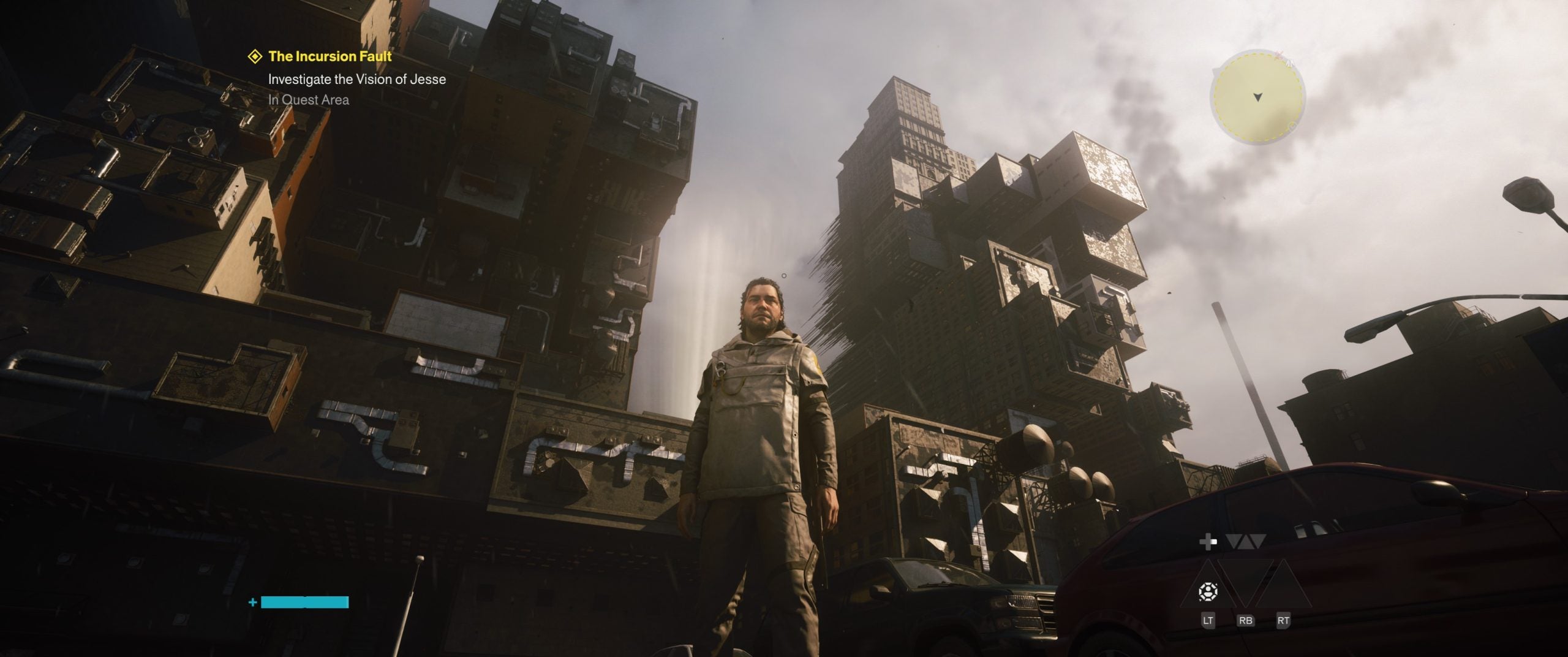
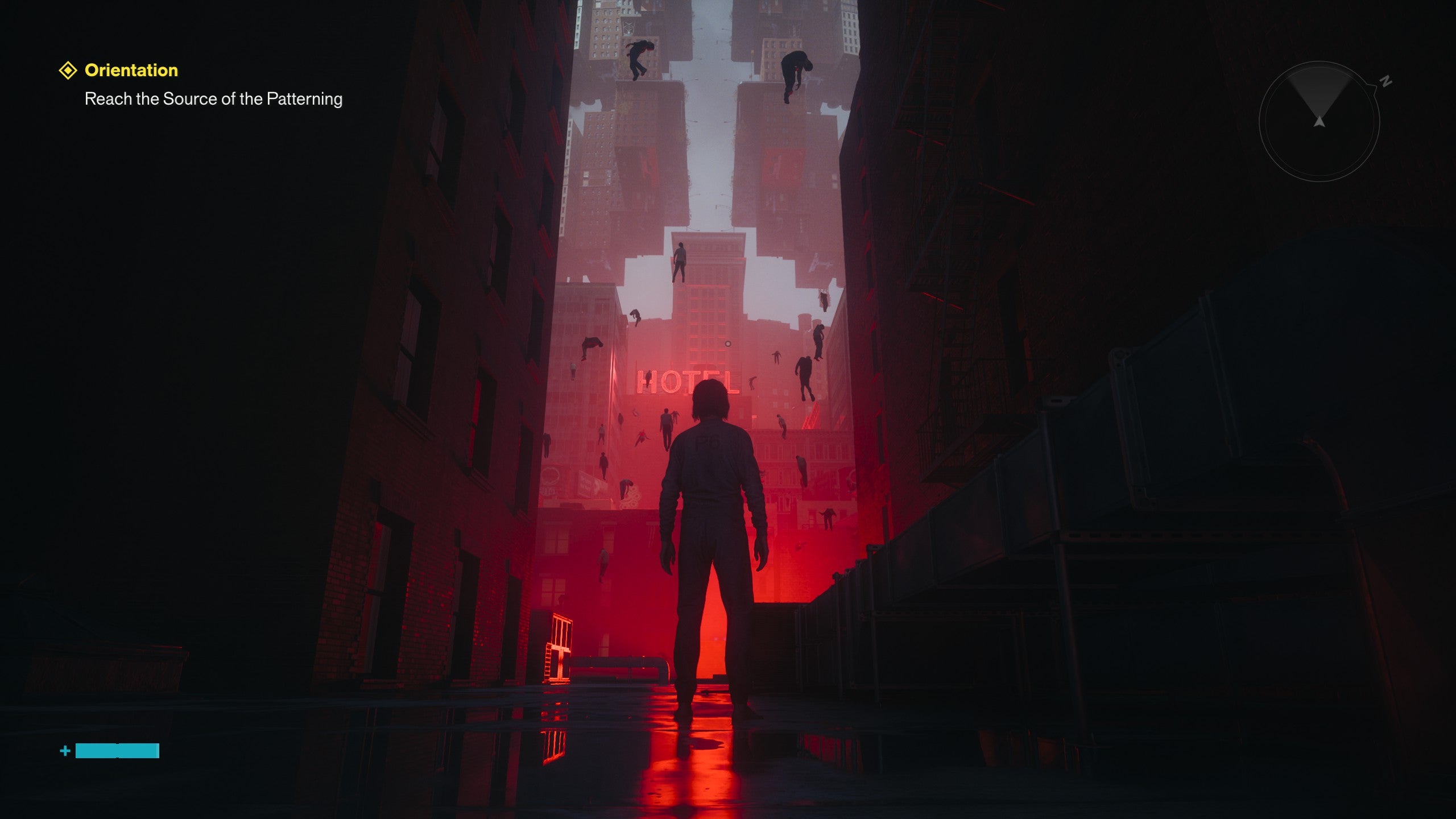
When you step up to your first precipice of impossible geometry after exiting the doors of The Oldest House, and bear witness to thousands of hiss-possessed bodies dispossessed of their former wills floating urgently over and through the cavernous vista of tessellated city blocks, your heart gives a little start and your stomach sinks deep down into the place within your soul where light can’t touch as you gulp hard and think to yourself “oh… shit.“

One of the most delightful aspects of Control (2019) was that somehow, against all reason and understanding, everything that Jesse Faden endured in her quest to find and free her brother, Dylan took place within the walls of The Oldest House, the mysterious, unremarkable (to most) building that only reveals itself to those it deems worthy of finding it. The ordinary (not Ordinary) office building that, once entered, contains multitudes beyond multitudes, mashing together the iconic brutalist design of late 1960s Federal office buildings with gateways to other places within and beyond time and space. A seemingly infinite space, a threshold of thresholds, endlessly expansive, containing any and all possibilities required by the Federal Bureau of Control. <Infinite/endless/forever, yet contained/bounded/leashed.>
You could just about wrap your mind around it by assuring yourself that no matter how strange things got, how bizarre it seemed, at least it was all happening inside. At least it wasn’t going to get out. You would see to that, with the help of the Ahti the janitor and some video recordings left behind by Dr. Darling and hints from Polaris, when she chose to speak. And occasionally Former Director Trench, from beyond the grave. And The Board, who, let’s face it, were the one(s?) pulling the strings all along. You had this under control, though. Or you would, soon enough. Knowing it was all happening within gave the whole thing a sense of paradoxical structure. <A convenient reassurance/security blanket.>
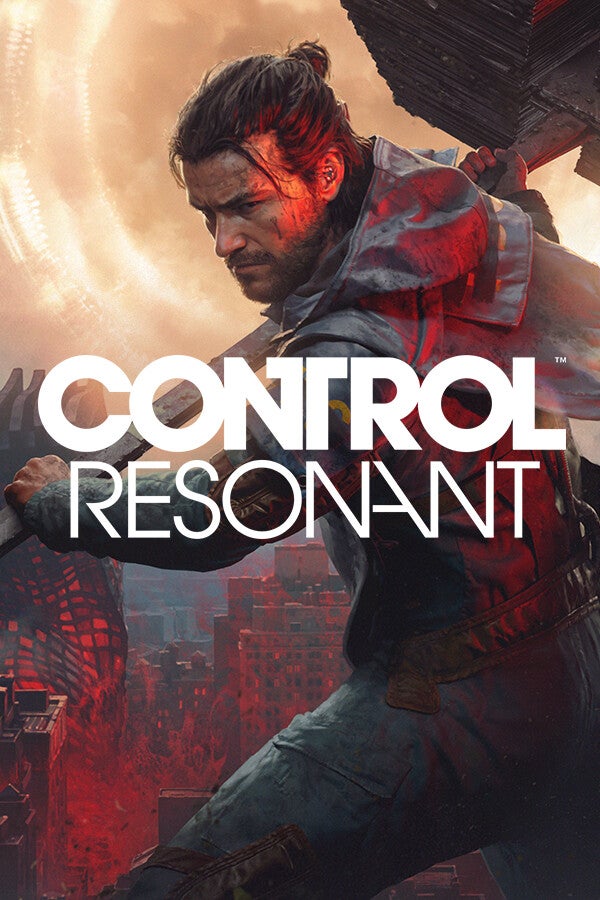
Seven years on, Control Resonant realizes the worst case scenario the FBC could imagine; The Hiss have broken containment, escaped The Oldest House and begun to spread virally through Manhattan, and Director Faden has conveniently gone missing at the worst possible moment. You are <her brother/the main character/a contingency plan.> As Dylan Faden, waking up from a seven year coma with a reputation to clear and a mission given to you by Jesse, what choice do you have but to push forward?
Control Resonant is the rare sequel that simultaneously builds on much of what was great about its predecessor while also throwing a lot out in and trying something new in the name of experimentation and asking the question, “what feels like the right fit for the player character?” I wasn’t the biggest fan of Control (2019)’s shooting mechanics; Remedy has no problem making a shooter that feels good to play, but for me at least the interplay between Jesse’s abilities and the Service Weapon’s various functions was harder to get right than I would have liked for it to be in a lot of cases, especially during the third act and in some of the DLC expansions where the encounter design got very difficult.
So this game doesn’t have guns. Dylan doesn’t shoot, the Service Weapon isn’t available to him because he’s not The Director, but Jesse has seemingly granted him the use of the melee weapon Aberrant, a solid metal <rod/object/shape> that can change form and function to act as a variety of melee weapons. Leaning on Dylan’s Parautilitarian status and life of training as a Prime Candidate for the FBC, he is quickly able to wield Aberrant and harness several movement abilities that, to my mind, set him up as a significantly more powerful (or capable) force at the game’s outset than Jesse was at the beginning of her journey.
Resonant doesn’t have to spend much time with setup and world building as it presumes you’ve played the previous game. Instead you get dumped right into the action, cutting down Hiss combatants and bashing your way through enemies while dashing and gliding and double jumping with relative ease. Dylan is highly mobile from nearly moment one, and the pacing of the combat scenarios feel kind with the pacing of the game’s narrative. Resonant‘s mechanics harmonize with its narrative extremely well, and it feels like a carefully considered and constructed experience.
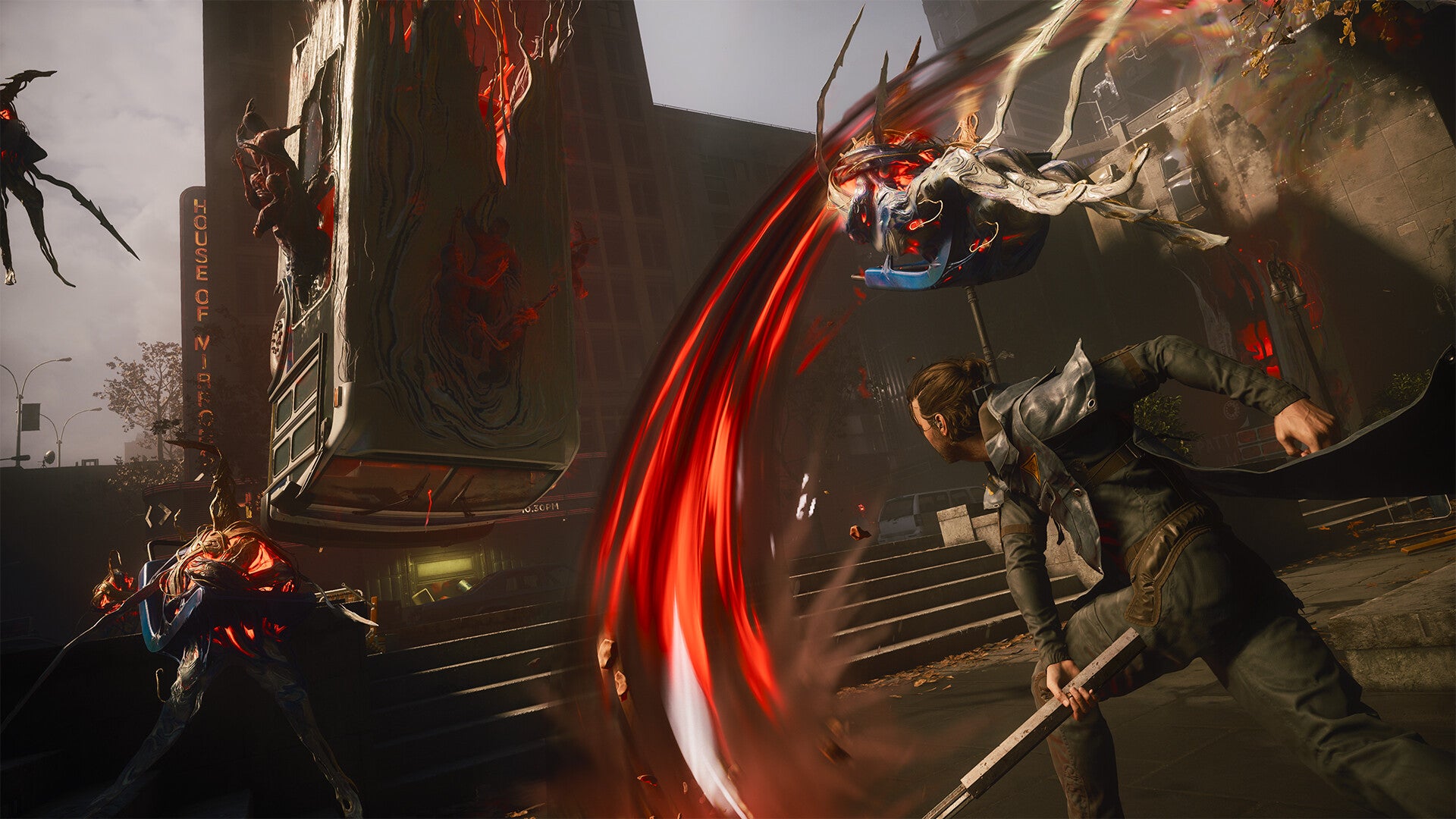
Remedy has created a melee combat system that frankly feels great to play. It sits in a nice middle ground between character action games that require deep combo memorization and more surface-level action RPGs where you’re swapping between primary attacks and casting spells. As you unlock more abilities within each of Aberrant’s forms and invest points in Dylan’s talent tree, you see the combat system deepen and build upon itself, revealing a design that’s extremely rewarding to play if you spend just a little bit of time thinking about how abilities can work together. The depth and variety of Dylan’s ability tree and the trees on each of Aberrant’s forms very rapidly escalates into a full on ARPG buildcraft exercise, where you are encouraged to experiment and find synergies and layers to your build that take Dylan from being Just Another Parautilitarian to becoming a destructive powerhouse with capabilities exceeding Director Faden herself.
I am a flurry of steel, stone, and speed, a whirling gale of death that catching all extra-dimensional ne’er do wells in my wake.
In the first hour or so I was mostly mashing my primary attack and dashing around to dodge, but after just a few hours I was carefully selecting a smaller enemy to shield charge into, instantly filling its Falter gauge and allowing me to perform a finisher, which activated my Powerful status that drastically multiplied my attack power, dashing to the nearest heavy enemy to cut it down in just a few quick attacks, performing dodge counters to provide further damage boosts and refill my Power meter, then repeating the whole process over again until every heavy enemy is dead. After only a few hours of play time, I became nearly untouchable in combat, which is a stark contrast to the early battles where Dylan feels more fragile and, especially prior to the launch day patch, enemies were harder to kill. I am a flurry of steel, stone, and speed, a whirling gale of death that catching all extra-dimensional ne’er do wells in my wake. I feel no rage, no malice; only unshakable purpose.
What you quickly realize is that the combat system is intended to be reward you for your investment in the skill tree and weapon upgrades, and you begin to seek out encounters not just for the resources they reward or for the sake of clearing out a city block or a rooftop to create more breathing room and beat back the Hiss threat, but because it is just fun as hell to dip in go nuts on them. Dylan has a pretty significant grudge to settle with the Hiss, after all; why not oblige him?
Manhattan itself is an incredible playground, and Remedy have very cleverly created a space that feels huge and open, bordering almost on being an open world, but careful examination shows some smart use of spatial design and segmenting of areas to create the illusion of an open world without having to actually craft something so expansive. There are discrete, specific paths between different areas of the map, neatly cordoning off distinct areas off from one another, even in cases where you might be able to see neighboring zones in the distance, you can seldom just go straight to them.
There are several other trappings of Open World games here; fast travel points in the form of shape shifting, freestanding doors are plentiful and allow for easy travel across the expansive city; radio towers that need to be activated to reveal portions of the map; check points that auto-save your progress; numerous side quests to take on and little shops to duck into for collectibles; ability upgrades nestled in special parts of a zone.
Most of these same concepts were present in the original Control, and I would argue that while Resonant takes place outdoors, it’s much more akin to something like a Metroid or Castlevania in structure. It somehow balances the freedom of choice and direction of an open world game with the distinct and separate “area” design. It is neither too open, nor too linear, and as with so many things Remedy, they have landed on a blend of genres that feels unique, and in this particular instance I think it all works extremely well.
When you consider that the design of the world and spaces in which the game’s action takes place are done with the combat system and freedom of movement in mind, the choice to go beyond The Oldest House into a cityscape transformed by The Patterning seems not just helpful, but necessary to support the notion of fighting back the Hiss as the younger Faden. Every design choice that Remedy has made feels so carefully considered in service of so many aspects of the game, it’s often hard to tell which choices predated others, and all of them are well-justified in the course of playing.
The Patterning as a narrative device provides the source of both an incredible visual direction for the twisting, turning, folding, repeating, spiraling, logic-defying version of Manhattan you navigate, as well as an incredible justification for how the Hiss threat has been contained within the city despite escaping The Oldest House itself. The visual direction of Control Resonant is utterly striking, and the feeling of wandering through environments that feel simultaneously familiar and completely new remains fresh and exciting throughout the journey.
The game’s strong motifs of reflections and familiar juxtapositioned against the foreign persist in every interaction you have. You are playing what is clearly a sequel to Control, something that feels like Control, and yet also feels like a totally different game. It has so much in common with the first game; the major players and characters, the enemy threats, the in-universe concepts, the skills and abilities, the supplementary files scattered throughout that build the world out. It also stars a different protagonist who fights differently, interacts with the world differently, has a vastly different experience interacting with FBC agents, is in a totally new and different environment transformed by paranatural forces, and is thus so much unlike what came before. <None of this is accidental/unintentional/a mistake.>
Speaking to the game’s performance, it is a visual stunner especially if you have the privilege to run it on a high-end PC. On Nvidia GPUs it takes full advantage of DLSS 4.5’s feature set, allowing you to tune the visuals of the game just as you want them to get the right balance between performance and quality. Playing on an RTX 5080 and a 3156 x 1440 ultrawide, with all of the graphical settings cranked up and ray tracing enabled, the game is real stunner, though taking advantage of DLSS upscaling ends up being a requirement to maintain reasonable frame rates.
Those frame rates can fluctuate greatly depending on whether you’re in an enclosed environment or an open one, so leaving headroom for the chunkier outdoor spaces is generally a good idea. With settings maxed, ray tracing on medium, and DLSS set to “balanced”, on the upper end the game sees about 110 FPS, and bottoms out between 65-70 under the most intense of conditions.
Disabling ray tracing and DLSS results in a much sharper picture overall, but the lighting and reflections you get with it are kind of difficult to pass on. Remedy has raised the bar significantly over Control and Alan Wake 2 in terms of what the Northlight engine can do with lighting and this is one of the few games I’ve played where I have felt that it’s worth paying the DLSS tax to enable ray tracing effects and ray reconstruction. The game still plays beautifully even if the image softens under DLSS upscaling, and the trade-off is mostly worth it especially since Dylan spends so much time in rapid motion.
The environmental effects in Control Resonant, along with its lighting and art direction, are really remarkable and a continued refinement of Remedy’s house style of otherworldly visual effects that look like darkness itself burning off of Hiss minions you’ve laid waste to, or thick clouds of Mold spores making the environment feel heavy and dank and dangerous. The world feels like an actual place you could see and experience, and the scale at which it’s being rendered is truly impressive. Manhattan, for all of its patterning and infestation by Hiss and Mold and Resonants, looks disturbingly real despite the sheer impossibility of the state in which you find it.
The more time I have spent with Control Resonant, the more amazing it continues to become. It’s a game that unfolds and reveals more about itself to you the deeper you go, and it makes a habit of setting a stage, letting you think that you understand what kind of game you’re playing or what the rules of the story are, only to switch things up on you and reveal another, deeper layer just as you’ve become comfortable. Actually, deeper is the wrong way to describe it; it’s like moving to a higher, more complex layer of understanding of what the world is, almost like moving through planes of dimensionality themselves.
I haven’t even touched on the Resonants themselves; twisted former humans who have somehow become bound to the locations they hold dear, their affinity for those spaces transforming them and amplifying their power. Behind each of these boss fights is a tragedy of loss and betrayal by the fundamental nature of the human experience. I said before that every aspect of this game’s design is highly intentional, and the Resonants are no exception to this; I am not being hyperbolic when I say that defeating some of them can be surprisingly affecting, when you see what they have lost or left behind.

There is so much to love about Control Resonant, and no amount of <praise/adulation/glazing> feels really adequate to explain just how special of a game it is. It may truly, be Remedy’s best game, certainly in terms of moment to moment gameplay, but also in the sense of how tightly woven every single component of it is with every other component. It is a work that is truly enriched by all of its parts, one which is highly memorable and immersive and rewarding to play at every moment. Every little touch of environmental storytelling, every voice performance, every tiny detail of the game’s writing, every single time Dylan busts out of a fast travel door in Central and scares the bajeezus out of the FBC scientists stationed right next to it, all of it makes the game feel like a carefully considered whole. It’s a remarkable achievement to make a game this dense and this heavily conceptual that absolutely hits at every single beat.
The point is that there is little I can say to do Control Resonant the justice that it sorely deserves. The best thing you can do is to <play/experience/devour> it yourself.