




Look, first impressions are hard. The moment you’re introduced, opinions begin calcifying, and you’re immediately trying to outrun that process to get under the surface, expose the meat, plunder the depths. Find out if there’s more there there. What adventure awaits? What treasures lie dormant? What mysteries remain to be solved? Will you be nimble and open-minded enough to stave off the surging urge to dismiss it all outright as a fool’s errand?
Or will you succumb?
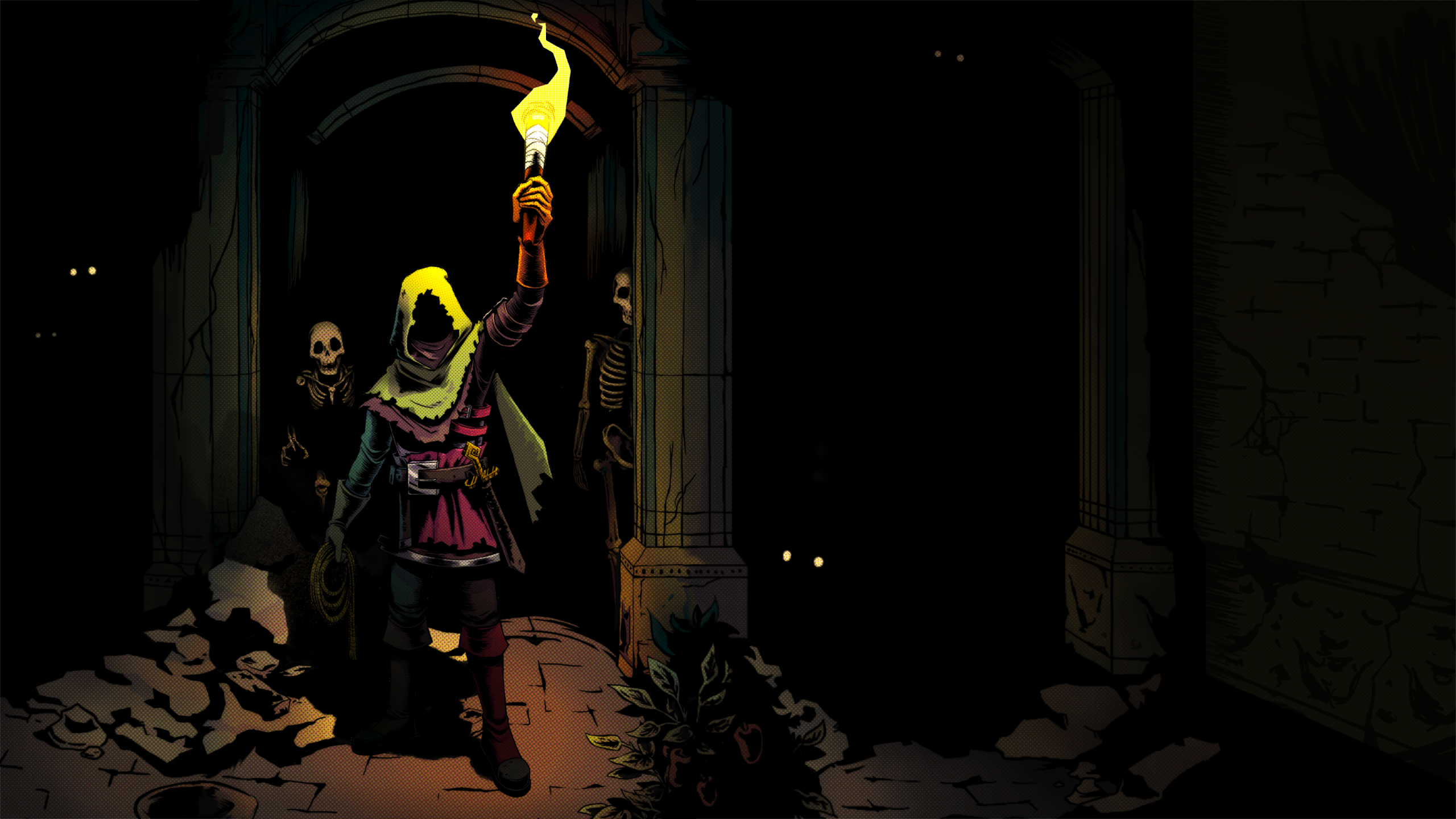
The opening moments of Deep Dish Dungeon had me fighting. Not, like, you know, with enemies. But with expectations. I was, of course, drawn in by the allure of the art direction–opinionated, pixelated, blocky visuals, a general dour, foreboding murkiness that conjured memories of playing King’s Field at my friend Nate’s house probably thirty years ago at this point (oh no, I’m old!). I was, of course, intrigued by the promise of a hand-crafted dungeon-diving adventure. Titillated by the familiar mechanics of a mix of genres: Survival! Crafting! Metroidvania! These are words that I have come to know and love! And while my obsession with all of them has waned over the years, I was still open to be drawn in once again by something fresh.
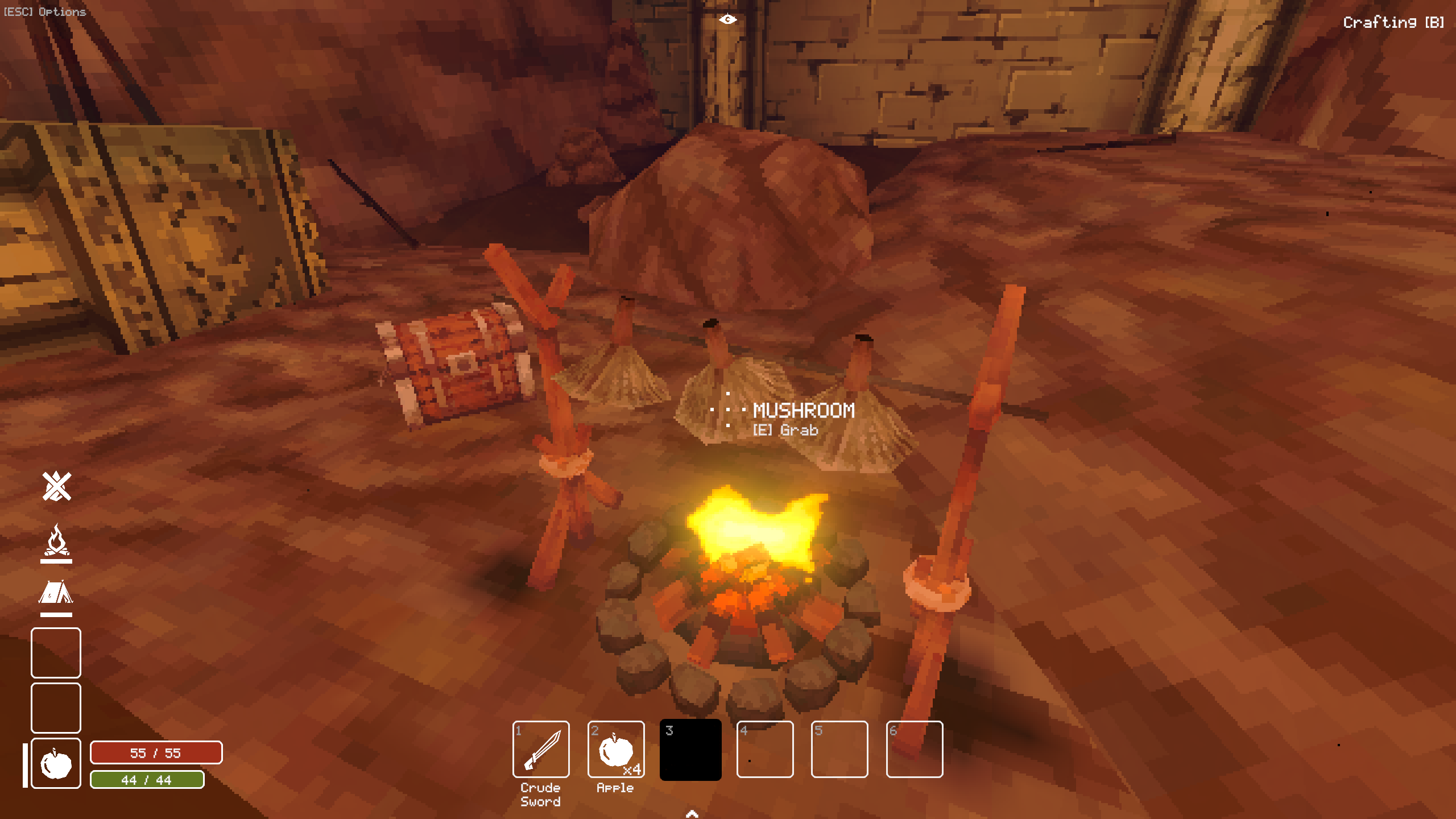
And so I created my character with the limited customization tools available to me. I listened to some underwhelming narration attempt to set the tone for the hours ahead. And I awoke in a cave and set out on my grand quest to, uh, do, uh, something, I guess. Oh, I guess pick up this stick. And this one. And this one. Oh, and here’s an apple. Cronch. Okay, yeah, now the apple is in my tummy, indicated by the tummy meter in the upper-left corner. This is a survival game! Already mostly living up to the expectations set by its name: Deep Dish, like pizza (food) and Dungeon, like dungeon (dungeon). Deep Dish Dungeon, a delightfully dispersed triad of plosives. Dah. Dah. Dah. A lot of whimsy in that name, yes, a lot of (perhaps inadvertent?) parallels between this and, say, a wacky anime? Surely, many hours of joy were ahead of me, right?
Right??
But as I wandered around, rummaging through detritus, something felt wrong. The awkward movement. The imprecise aim. The dead zone on my analog sticks seemed larger than usual. And worse (the real culprit), they were not being treated as analog sticks at all. The inputs, instead, were digital. On or off. Yes or no. True or false. My thumbs rested on booleans. My character and my camera moved at the same speed, regardless of how aggressively or not I tilted the sticks. This was unexpected behavior! Most games, you tilt the stick a little and the camera moves slowly, tilt it more and it moves faster. Not here in the dungeon!
And it felt bad. Picking things up felt bad. Jumping around felt bad. Manipulating things in the environment, ALSO BAD. The experience of playing on a Steam Deck (verified! If you’re curious) was immediately off-putting. Clunky, some might say.
But what choice did I have? It’s the only PC available to me that can play this (the Mac client was not available for review). My real big kid PC was now in the hands of a friend’s child, a parting gift before I left my home to move to the other side of the world. It didn’t make sense to lug that thing with me. The Steam Deck would have to do.
And so I wandered. I fought with the controls, hoping that I would eventually adjust (and I realized that when I did need that extra precision, switching to the right trackpad sufficed). I explored corridors. I stacked crates to create an impromptu path from one floor to another. I dragged a giant plank around to make a ramp. The physics puzzles, to their credit, were immediately engaging, and Deep Dish Dungeon trusted me, the player, to use my ingenuity to explore. It wasn’t long before I made my way out of the starting area to what would become my main camp: a sleeping bag, fire pit with rotisserie, and a small chest to store things. Inside, a letter.
Someone had been here. Were they still alive? Who could say! But the law says, “Finders keepers.” I was glad to put their leftovers to good use.
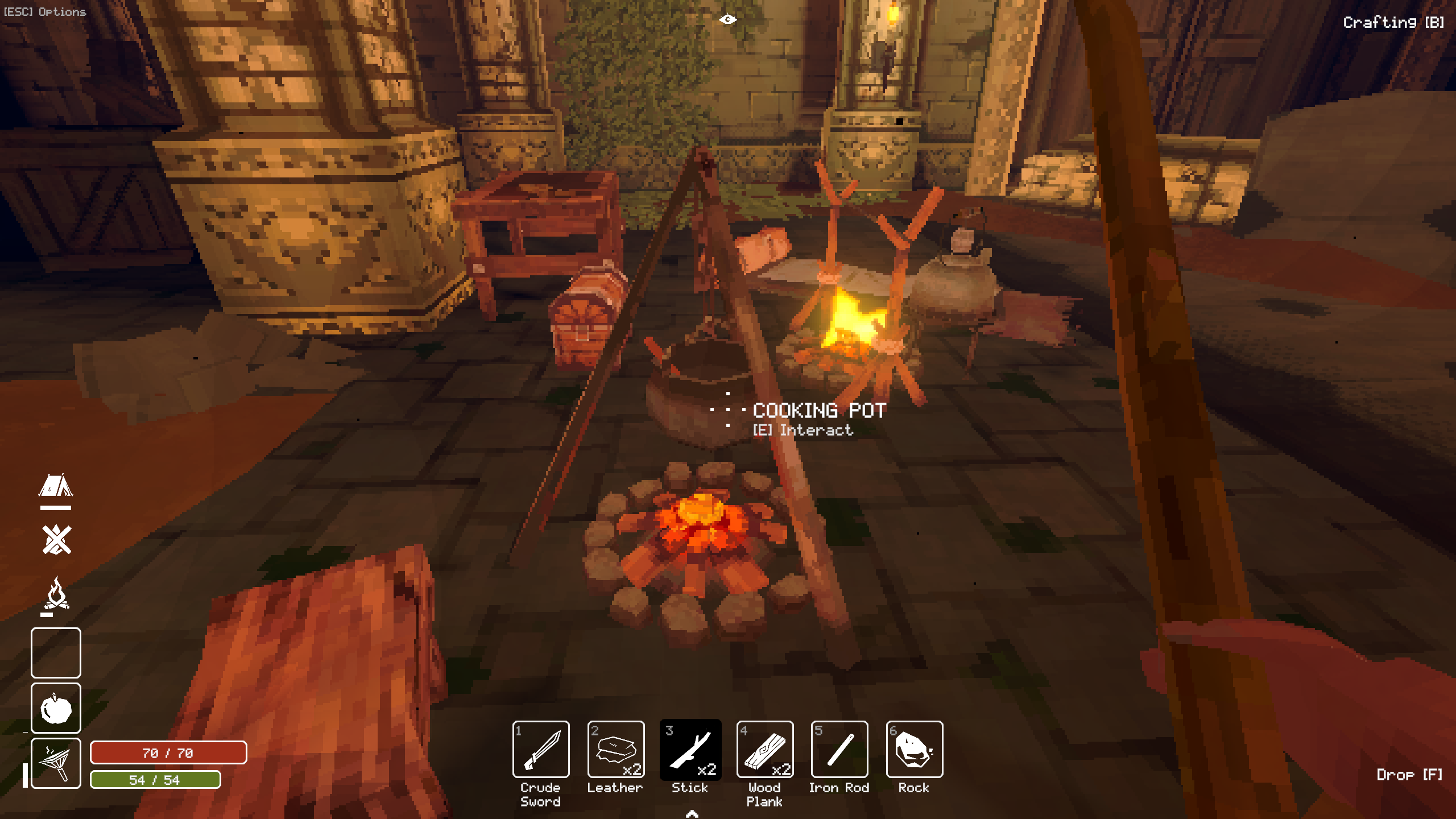
Speaking of leftovers, I quickly learned just how important food was. Similar to Valheim, you can stuff your tummy meter with up to three unique foods and/or beverages at a time. Different foods offer different benefits. Cooked foods are typically better than uncooked. A raw apple, however crunchy and delicious, is not as nourishing as a roasted rat, naturally. As long as your hunger is sated and your thirst quenched, you’ll have additional reserves of stamina, health, and regenerative capabilities, keeping you alive for just a bit longer. Ignore your basic needs, and you’ll slowly wither away until you die and, I suppose, become a skeleton whose pile of bones lie dormant until the moment another adventurer wanders past, at which point said bones will reanimate and catch the passerby unawares, killing them in two, maybe three swift strikes.
Seriously, what the fuck is going on with the enemies in this game? They’re not particularly savvy, to be fair. In fact, they won’t really chase you long distances. They won’t even follow you around a corner. Once they lose sight of you, or you’ve gotten too far away, they kinda just throw up their hands and wait for you to return. A behavior you’ll end up taking advantage of, because, at least early on, you’re not really capable of tanking an ulna to the temple.
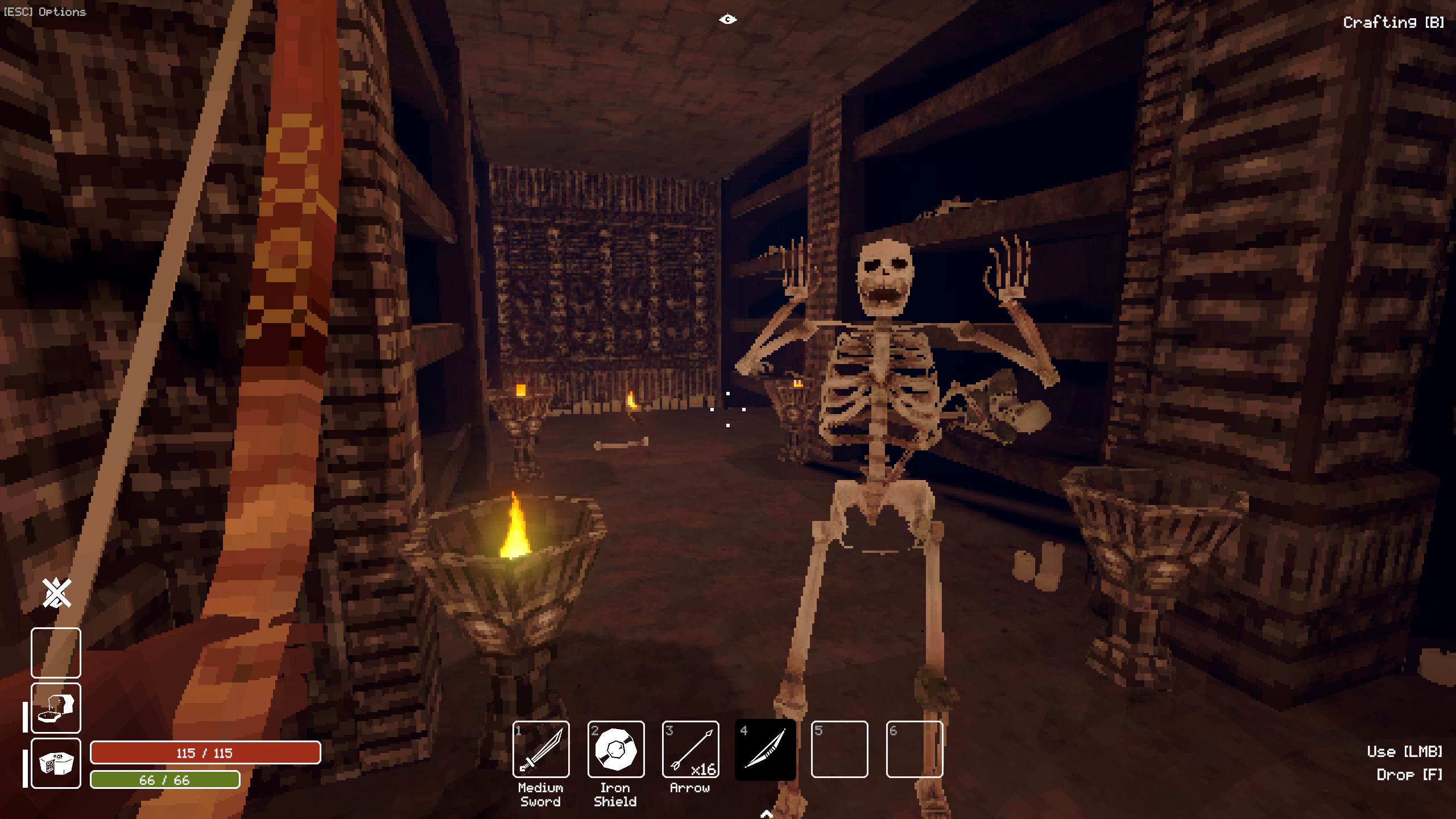
Death comes for us all, and it comes swiftly in Deep Dish Dungeon. The opening hours, especially, were a frustrating mix of wandering through myriad halls, picking up items off the ground, and getting merked by a skeleton. Or an eel. Or a giant bat. Or a large pit. Or a scorpion whose friend I had just killed. And your character’s moveset is limited. You can sprint forward, or you can walk backwards. You can block with a shield if you have one, but otherwise there’s very little you can do to mitigate damage without cheesing enemies. So I would often die and then I would then respawn at my sleeping bag and make my way back through the labyrinthine ruins to retrieve my shit, hoping I wouldn’t die again in the process.
Playing solo taught me the importance of scurrying back to my camp to top off my food and drink meters and store new goodies in my chest. I became a master of guerrilla warfare, sneaking behind enemy lines to loot a chasm or a prison, stuffing my pockets full of materials and food. Over the course of a couple hours, I amassed an array of rocks and vines and planks of wood. I crafted a new chest. I built rat traps and I skinned those rats for their meat and their hides. I made a backpack out of them. I called it my ratpack.
I climbed on top of boxes. I crawled up a rope nailed to a wall. I clambered up the stone columns and arches supporting the expansive room that housed my camp and thought that maybe I had broken the game and gotten somewhere I wasn’t supposed to be.
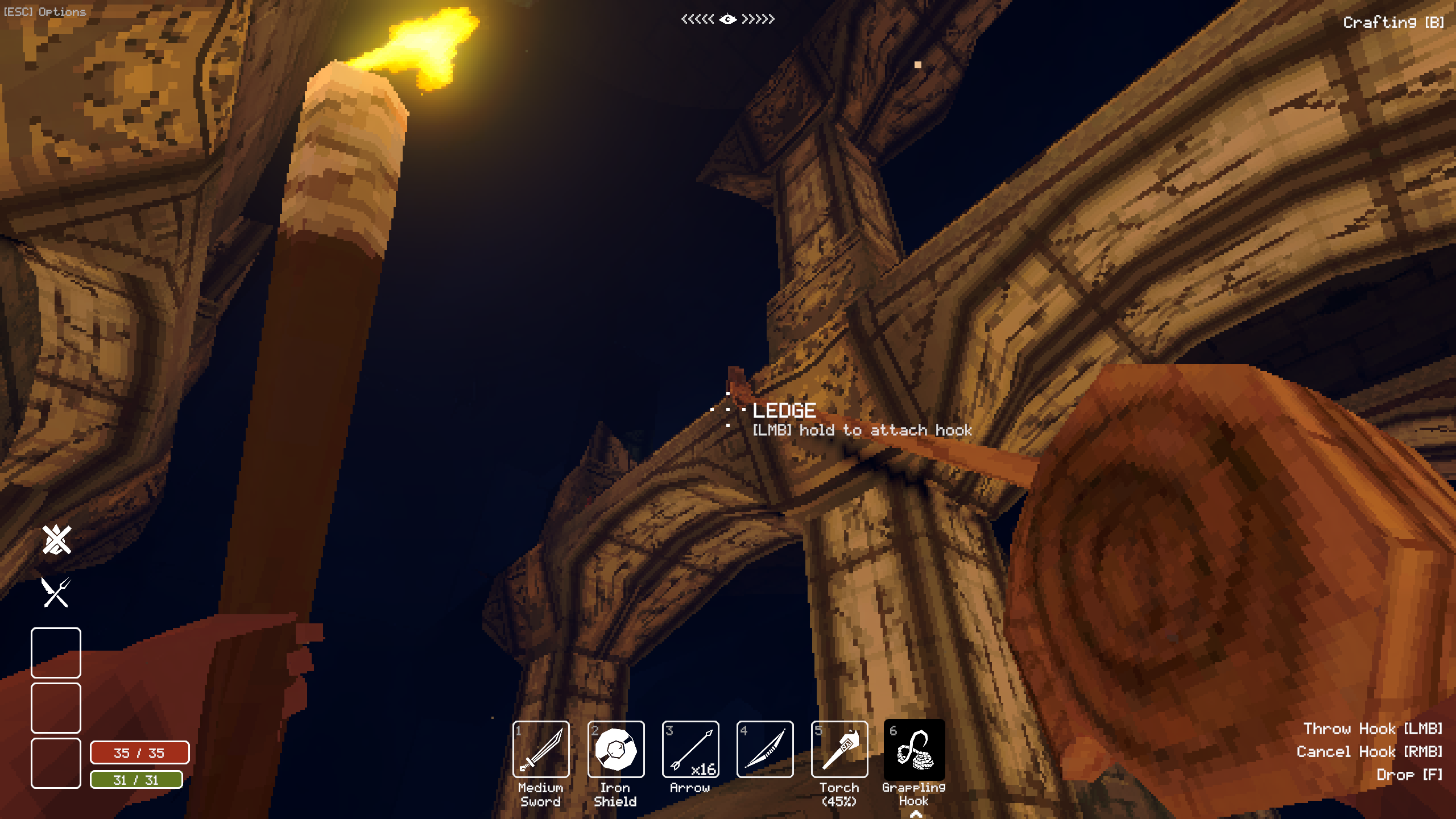
Then I found a piece of treasure tucked away and it was then that I remembered that, oh, this is hand-crafted. If a nook is there, it was probably placed there with intent. I jotted that down, which is a metaphor for I simply remembered it with my brain.
But what I also did was hit walls. Figuratively and literally. After I had explored seemingly every inch of the area available to me, all that was left were barriers to progress. Rusted metal bars. A thick patch of vines impervious to my shitty sword. A dense cluster of spiderwebs. Giant piles of goo called “goo piles.” Doors, so many locked doors. I tried my best to intuit what the game was telling me. Deep Dish Dungeon is not a particularly forthcoming experience, with regards to information. There’s no explicit tutorial. There aren’t really any tooltips or hints (except for the brief flashes of text on the death screen). There’s no inner-monologue to remind you of your current objective. There’s no quest marker or map. It’s easy to get turned around and second guess yourself. And so as the novelty of the initial exploration wore off, all I had was a desire to move forward, but no clear way with which to do that.
Until I saw it. A hammer. Behind a metal gate. A metal gate I couldn’t fucking open. I spent an hour or two walking back and forth through the same hallways. Turning valves. Climbing ladders. Killing respawning skeletons. Looking for any way to retrieve this item that I was now sure would help me make some forward progress. I got so irritated by how stupid it made me feel that I shut the game off and thought about giving up completely. Life’s too short. Death comes for us all.
But I had made a promise to my friend, Scott, Editor-in-Chief of Saving Content, this very website. I told him that I would review this thing. And it was that promise that echoed in my damp, reverberant halls of my mind. My brain had become its own dungeon, and I had no choice but to find my way out. By god, I would find the conviction to overcome this game. It would not get the best of me.
And that’s exactly what I did. Honestly, it was pretty annoying! I found the path to the hammer. Turns out, it happened to be down the one hall I didn’t fully check due to an enemy making me think I wasn’t supposed to be able to go down there yet! Shame on me.
Once I had the hammer in hand, I ran around smashing every rusted steel bar I could find. Legitimately cathartic. What once felt like an oppressive prison was now reckoning with the strength of Mark, which is what I named my hammer. It was the exact taste of progress I needed to keep me going. The loop of exploring a new area until I got stuck and eventually figured out where to go became less irritating and more invigorating. As the dungeon opened up, it revealed a world far more intricate and massive than I anticipated. Long, arduous paths that looped around and weaved back in on themselves. Unexpected shortcuts. And an array of items to craft or find that really started to open up the possibilities for not just survival, but thrival.
Eventually, my modest camp evolved from a sleeping bag and a campfire to a sleeping bag and two campfires. I had a handful of chests keeping all of my belongings safe. I could make stews in my cooking pot to raise my health and stamina more than rotisseried rat (ratisserie, if you will). And I built a workbench so I could craft even more elaborate items to aid in my adventure. At that point, when I wandered out into the darkness, I was no longer afraid of what awaited me. I became the fear and inflicted it upon every dipshit who stood in my way.
It took time, patience, and perseverance, but the result was ultimately a solid combination of power progression mixed with added knowledge of the game’s world and its mechanics. There’s a wealth of riches buried within.
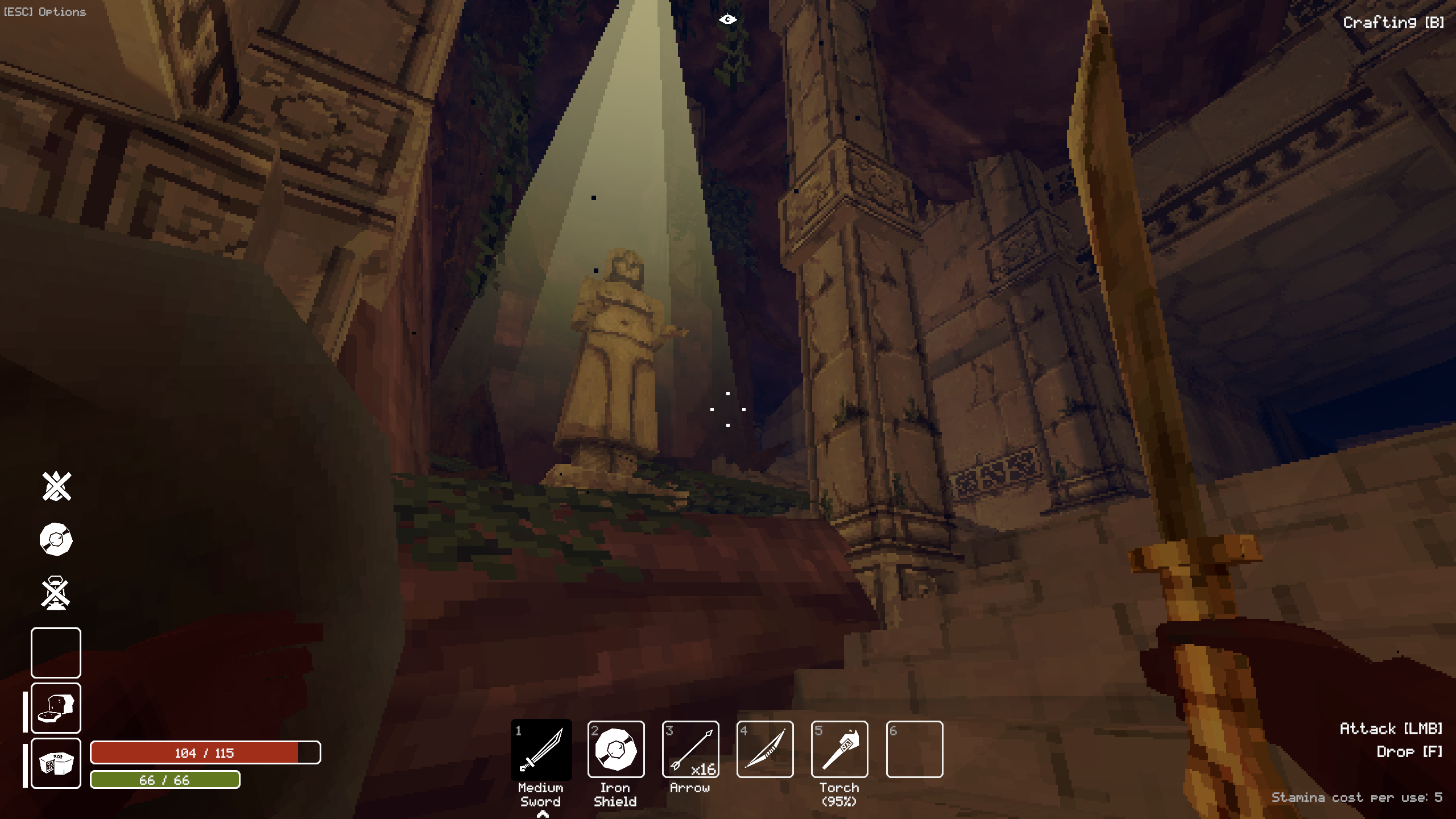
Brief aside: performance-wise, I didn’t really experience any issues. I set the rendering quality to High, and capped the Steam Deck’s FPS at 45. Battery life was terrific, giving me multiple hours-long sessions. The game’s art style lends itself to a lean and efficient experience that I assume will run well on most systems.
Now, obviously, it’s not without some rough edges. Mostly the experience with a controller (I know, I know, I’m still on that). While I did eventually acclimate, I would really love to see them honed to feel more modern. Obviously, I tried playing with a mouse and keyboard plugged into the Steam Deck, and it certainly feels like a better experience, but not how I want to play games on a handheld.
It’s not just moving about the world and interacting with objects and enemies within it either. Navigating the UI with a controller is also a bit of a chore, especially when the crafting menu blocks the top row of your hot bar when wearing a backpack (on the default UI setting, which is set to large; setting this to normal alleviates the issue).
And I do have a bunch of, just, you know, lingering game design questions for this one. Like, what’s the logic behind the respawning enemies? Why does one enemy respawn in 30 seconds, while others stay dead for hours? What was the thought process behind the randomized loot spawns (it’s a little confusing, actually! Like, I’d be wandering around a hallway, picking up sticks, only to turn around and there were more sticks on the ground, making me think I had just missed them the first time, or at worst, making me think I got turned around completely), and are there guaranteed spawns of certain early-game materials so you’re not stuck looking for leather before you have any way to craft it? Why is it called Deep Dish Dungeon? Why the emphasis on food? I recognize there are plenty of ingredients to gather and ways to prepare them, but also it doesn’t feel like I absolutely need to engage with this mechanic at the depth offered (gasp: DEEP Dish Dungeon, a dish dungeon with depth!). Am I wrong? It feels like it should be a more central part of the experience, but the cooking stuff ends up coming off as a little superfluous, which makes me wonder if they just got really hung up on the name. Cute name, sure, but almost makes me feel like it should be attached to a cozier, cooking-based adventure, I dunno!
Also, it needs to be said that I can’t help but wonder how this experience would’ve been different had I not been experiencing it on my own. The game allows for up to three adventurers to party up and explore together, and there are definitely times where a puzzle seemed to be designed with multiple people in mind. Not that it wasn’t possible to accomplish solo, obviously, it was just more tedious. I’m curious if the early-game frustration of limited storage space could’ve been alleviated somewhat had I had partners in the journey. Would it have been less frustrating solving puzzles if I had had access to multiple perspectives? Would there have been more emergent wow moments as we all worked together to get out of a sticky situation or make a cool discovery? Would the proximity chat stuff have felt exciting and frustrating as you lose track of your friends in the depths?
Frankly, I’ll never know.
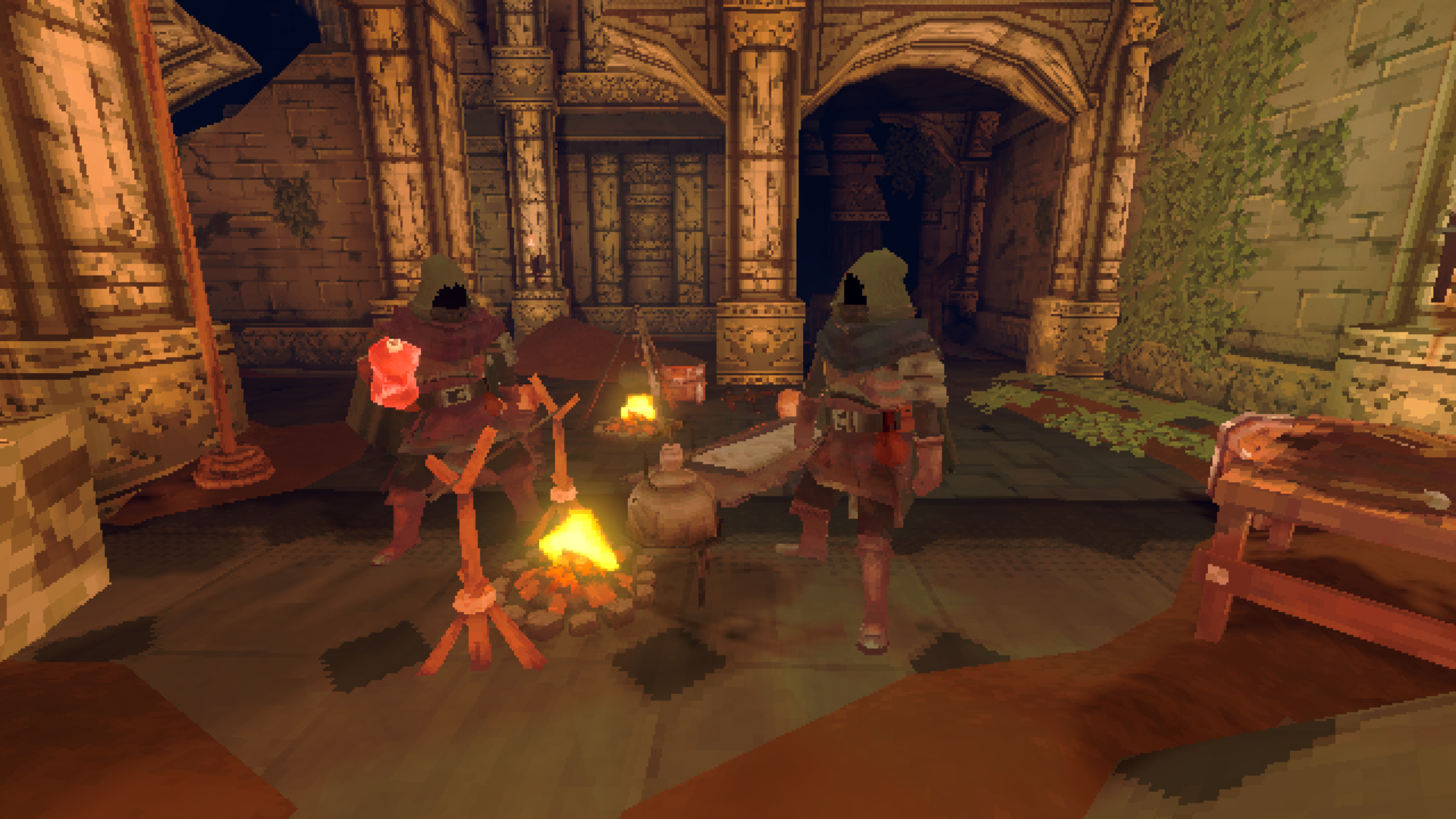
At the very least, I’m glad I stuck with it. While there were some periods of frustration with the world design, or puzzles that felt particularly obtuse (or at the very least made me feel particularly obtuse), the overall experience I had playing this game was rewarding. The sense of discovery. The fulfillment of reaching a new area using the tools you’ve crafted or found. Stumbling upon a new piece of gear that helps you feel noticeably more powerful than you were before. Unlocking shortcuts. The realization that the long, winding path you’re traversing will eventually bring you back where you started, revealing an intricate network of interwoven hallways. Dang! It won me over. First impressions be damned.