It’s been a full twenty years since CAPCOM released a mainline Onimusha game. While the recent remasters of the first two games kept the memory alive (I’m ready for my Onimusha 3: Demon Siege remaster with Jean Reno, CAPCOM), Onimusha: Way of the Sword is a complete reboot of the series. Apart from the signature soul-stealing gauntlet and soul-absorbing mechanics returning, it forges an entirely new path. Despite a slow start, this is a triumphant return for the franchise where combat rules.

The story begins with a corruption known as malice taking over Kyoto, Japan. We then are introduced to Miyamoto Musashi, a real person from history who has the face likeness of late actor Toshirō Mifune. Special shout out for the excellent facial animations here, really expressive and able to convey exactly the type of person Musashi is. In a lot of ways, this game is portrayed as an action comedy, like a RGG Studio game almost. There’s a real sense of humor and awareness, despite all of the horrors that are surrounding Kyoto. Musashi himself is swiftly shown as cocky yet skilled, and even funny. Very quickly he escapes one danger of being outnumbered at a temple only to discover the horrors of the Genma that are now taking over. These demons outnumber him, and skewer him like a human KerPlunk. He’s also a purist when it comes to sword fighting, and views wearing the Oni Gauntlet as a taint on what a samurai should be, so he has a code.
The tutorial and general onboarding in Way of the Sword is probably my least favorite thing about it. The game doles out systems at a feverish pace, but never overwhelming. Yet, the tutorial ends and you’re set free after the first five hours. It’s here where you get to engage with all of the systems, but they are put to the test in boss fights where they show you have to pay attention and use what you’ve learned. This is not a soulslike beyond its tough combat, this is still a character action game, and CAPCOM really puts a tremendous effort into the character of this character action game. It’ll take you over 20 hours to see the ending if you mainline it, but not even having done everything, I could see this in upwards of 50 hours. There’s a lot of game here, and besides the story, a lot of it is optional. Though if you spend time exploring the world, taking it in, and engaging with the people, you’ll become stronger for your efforts.

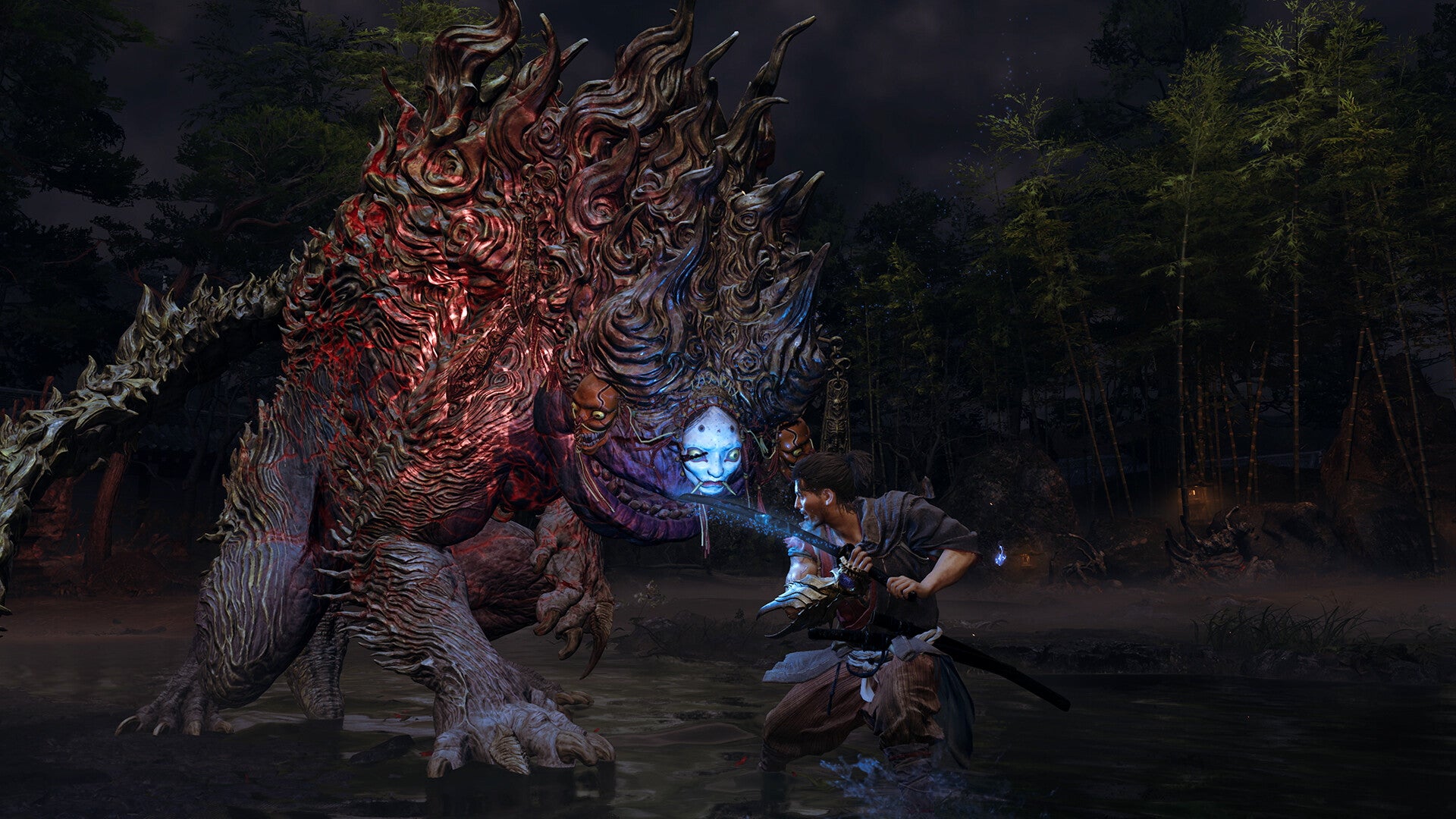
Combat is dense and varied. With it being a character action game you’ve got light attacks that are done one-handed, and heavy attacks as two-handed. You can block and dodge, but the parry system takes on a life of its own – more on that later. It’s not long before you’re given a bow with infinite ammo, which is mostly used for puzzle solving like moving otherworldly boxes or destroying tethers in the world. Of course you can use it to take out other archers or enemies at range, but it doesn’t do well to support multiple enemies as target switching is not very fast. In a sort of ultimate, you’ll have access to six Oni armaments which were actual weapons you’d wield in prior Onimusha games. Whether they are dual daggers, a naginata with two blades on the end, or even a lightning spear. These weapons don’t operate on a cooldown, instead you must consume souls to make it available for use again, but it doesn’t come often. Every attack you perform is weighty and deliberate, yet accessible for those who aren’t versed in soulslikes.
I think what makes special mention is how parries are essential to the combat. Parries have various forms, but the strongest is issen. If you perform an issen, or a critical counterstrike in the split second before being attacked yourself, you will counter it, and attack the enemy for very high damage. The timing of this to get right is very precise, and I feel I only ever got it during the tutorial and on accident, never deliberately despite trying to do so. All of this together gives Sekiro a run for its money. Every animation is incredibly smooth, and seems unique for every enemy and boss. It looks and feels cinematic. This is exemplified when you can use parts of the environment as part of your attacks in the same way Jackie Chan would use it in something like “Rumble in the Bronx”. You can pick-up a knocked down door with your sword, use it as a shield and then push it towards your enemies to take multiple out at once, or wheel a cart into them. It’s both hilarious and highly effective, and very fitting within the confines of the game.
Death is inevitable, but here you get to keep everything on you. A Devil May Cry-style glass-break screen announces your demise, it’s a brilliant touch. When facing off with a boss, there will be a checkpoint right before then, and the menu will let you enhance or upgrade equipment prior to trying again. You must get comfortable with death, it’s the best way to learn. However, if you die five times in a row, the game will add a menu item to lower the difficulty. Story difficulty does exactly what you think it does, it makes it so you hit harder and enemies die faster. What it doesn’t do, is make things easier. Bosses won’t be pushovers, you’ll still have to learn their attack patterns and phases and properly use the parry system in order to survive. On story difficulty, the game will also show you button prompts you’re supposed to press when a certain attack is inbound, but it won’t tell you when to do it. Irrespective of difficulty selected, there’s an accessibility option you can enable on the default difficulty that lets you see these button prompts while maintaining the challenge. When you beat the game, you’ll unlock New Game+ to replay the game with everything you’ve unlocked, as well as a much more taxing, Carnage difficulty to play on. For a game straddling a line across two genres, it handles it very well while maintaining a challenge for all.
Way of the Sword ditches the linear, mission-based structure of the prior games for an open-world. Now this might be groan-inducing for some, but is par for the course in recent years for games like this. The open-world can be overwhelming, especially as the hours go by and more things become available to you. As you clear away the malice from Kyoto and the surrounding area, villagers will come out of hiding, and immediately need things from you. So these pop-up missions are fairly low stakes and simple asks, but the rewards will feed into your inventory towards upgrades you’ll need. So partaking in any and all quests you get will always be rewarding, if not now, then later.

Equivalent to bonfires, are spirit mirrors. These serve as your way to fast travel to other spirit mirrors you’ve discovered, pull things out of storage, and manage upgrades. Much like the prior series, you must snatch the souls out of the air by using your gauntlet to suck them up and keep them, else enemies will take them for their own and empower themselves. Consuming souls has now become a risk/reward mechanic, and deciding when to do it before it’s too late is a careful balance to strike. Souls come in different flavors: red souls are the game’s currency for purchasing upgrades, yellow souls are used for your Oni meter, and blue souls are your life essence. Itemization and resources do feel familiar to that of soulslikes, but the buffs you can apply like enhancing defense, attack power, restoring life, all serve their purpose. Upgrades take many forms, you can enhance your clothing, sword, and gauntlet to become strong and more resilient. While you can invest in a skill tree to focus Musashi in various ways that align with your preferences. It’s all systems you’re familiar with, but with role-playing skills as opposed to generic stat increases.
At any point you can open-up combat drills that allow you to engage in extended, focused tutorials on basic to advanced elements of the game. You’ll be taught from Musashi’s now-mentor, Takamura Ono. There’s even an option to replay bosses you’ve already conquered, and you can do this across the two difficulties. The best part of all of these is that you get rewarded with items for each one you complete. Now, if you don’t use the spirit mirror to replay bosses, know you’ll run into them several times. This is a deliberate choice to perform skill checks to ensure you know how to defeat them, though it doesn’t become monotonous. These former bosses become like regular enemies as you’ve memorized everything about them, and it makes you feel powerful putting them away with ease.

Onimusha: Way of the Sword‘s world is muted due to the malice, but contains a lot of beauty, ready to be revived. And the time it does introduce vivid colors is well-timed. Musashi’s sword and clothing will be blood-soaked by the end of every battle, and it’s such a crucial, important detail of many throughout the game. Once again, the RE Engine does it again to provide gorgeous visuals and great performance. With everything maxed, I was able to get on average 110fps.
◆Linux 7.2.3-1-cachyos
◆Intel Core i9 13900K @ 5.8GHz
◆ASUS ROG RYUJIN II 360 ARGB AIO Liquid CPU Cooler
◆G.SKILL TRIDENT Z5 6000MHZ 64GB (32×2) DDR5 RAM
◆ASUS ROG Strix GeForce RTX 4080 16GB GDDR6X
◆WD_BLACK SN850X M.2 (8 TB)
◆LG UltraGear 34GP950B-G (21:9 Ultrawide @ 3440×1440)

No longer slumbering, Onimusha: Way of the Sword is a fully realized successor to Onimusha that makes it more than it ever was. CAPCOM has managed to reinvent and reinvigorate the series for new and old fans. Onimusha: Way of the Sword offers excellent soulslike combat and systems within a character action game, representing a new hybridization of game design I’m all for. Parries carry the game to make the combat exciting, deep, and rewarding. As Takamura Ono says, “Just sublime, boy.”